
version-3.0.md 14 KB
NetBox v3.0
v3.0-beta2 (2021-08-13)
Enhancements
- #6829 - Extend GraphQL API to support reverse generic relationships
- #6931 - Include applied filters on object list view
Bug Fixes
- #6811 - Fix exception when editing users
- #6827 - Fix circuit termination connection dropdown
- #6832 - Support config context rendering under GraphQL API
- #6846 - Form-driven REST API calls should use brief mode
- #6871 - Support dynamic tag types in GraphQL API
- #6894 - Fix available IP generation for prefix assigned to a VRF
- #6934 - Correct prefix utilization and available IP reporting to account for child IP ranges
- #6953 - Remove change log tab from non-applicable object views
v3.0-beta1 (2021-07-23)
!!! warning "Existing Deployments Must Upgrade from v2.11"
Upgrading an existing NetBox deployment to version 3.0 **must** be done from version 2.11.0 or later. If attempting to upgrade a deployment of NetBox v2.10 or earlier, first upgrade to a NetBox v2.11 release, and then upgrade from v2.11 to v3.0. This will avoid any problems with the database migration optimizations implemented in version 3.0.
Breaking Changes
- Python 3.6 is no longer supported. NetBox v3.0 supports Python 3.7, 3.8, and 3.9.
- The secrets functionality present in prior releases of NetBox has been removed. The NetBox maintainers strongly recommend the adoption of Hashicorp Vault in place of this feature. Development of a NetBox plugin to replace the legacy secrets functionality is also underway.
- The default CSV export format for all objects now includes all available data from the object list. Additionally, the CSV headers now use human-friendly titles rather than raw field names. If backward compatibility with the old format is desired, export templates can be written to reproduce it.
- The
invalidatemanagement command (which clears cached database queries) is no longer needed and has been removed (see #6639). - Support for queryset caching configuration (
caching_config) has been removed from the plugins API (see #6639). - The
cacheops_*metrics have been removed from the Prometheus exporter (see #6639). - The
display_fieldkeyword argument has been removed from custom script ObjectVar and MultiObjectVar fields. These widgets will use thedisplayvalue provided by the REST API. - The deprecated
display_namefield has been removed from all REST API serializers. (API clients should reference thedisplayfield instead.) - The redundant REST API endpoints for console, power, and interface connections have been removed. The same data can be retrieved by querying the respective model endpoints with the
?connected=Truefilter applied.
New Features
Updated User Interface (#5893)
The NetBox user interface has been completely overhauled with a fresh new look! Beyond the cosmetic improvements, this initiative has allowed us to modernize the entire front end, upgrading from Bootstrap 3 to Bootstrap 5, and eliminating dependencies on outdated libraries such as jQuery and jQuery-UI. The new user interface also features a dark mode option.
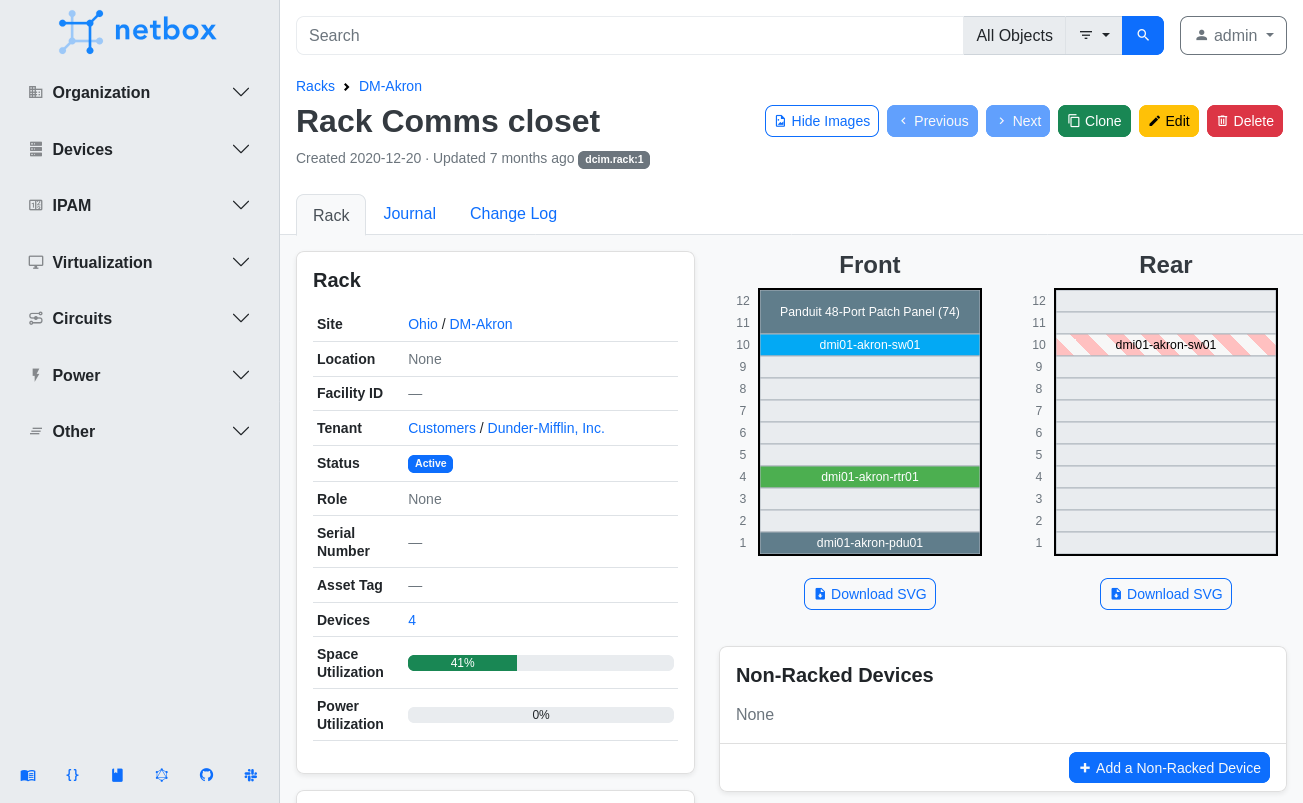
A huge thank you to NetBox maintainer Matt Love for his tremendous work on this!
GraphQL API (#2007)
A new GraphQL API has been added to complement NetBox's REST API. GraphQL allows the client to specify which fields of the available data to return in each request. NetBox's implementation, which employs Graphene, also includes a user-friendly query interface known as GraphiQL.
Here's an example GraphQL request:
{
  circuit_list {
    cid
    provider {
      name
    }
    termination_a {
      id
    }
    termination_z {
      id
    }
  }
}
And the response:
{
  "data": {
    "circuit_list": [
      {
        "cid": "1002840283",
        "provider": {
          "name": "CenturyLink"
        },
        "termination_a": null,
        "termination_z": {
          "id": "23"
        }
      },
...
All GraphQL requests are made at the /graphql URL (which also serves the GraphiQL UI). The API is currently read-only, however users who wish to disable it until needed can do so by setting the GRAPHQL_ENABLED configuration parameter to False. For more detail on NetBox's GraphQL implementation, see the GraphQL API documentation.
IP Ranges (#834)
NetBox now supports modeling arbitrary IP ranges, which are defined by specifying a starting and ending IP address (e.g. to denote DHCP pools). Similar to prefixes, each IP range may optionally be assigned to a VRF and/or tenant, and can be assigned a functional role. An IP range must be assigned a status of active, reserved, or deprecated. The REST API implementation for this model also includes an "available IPs" endpoint which functions similarly to the endpoint for prefixes.
More information about IP ranges is available in the documentation.
Custom Model Validation (#5963)
This release introduces the CUSTOM_VALIDATORS configuration parameter, which allows administrators to map NetBox models to custom validator classes to enforce custom validation logic. For example, the following configuration requires every site to have a name of at least ten characters and a description:
from extras.validators import CustomValidator

CUSTOM_VALIDATORS = {
    'dcim.site': (
        CustomValidator({
            'name': {
                'min_length': 10,
            },
            'description': {
                'required': True,
            }
        }),
    )
}
CustomValidator can also be subclassed to enforce more complex logic by overriding its validate() method. See the custom validation documentation for more details.
SVG Cable Traces (#6000)
Cable trace diagrams are now rendered as atomic SVG images, similar to rack elevations. These images are embedded in the UI and can be easily downloaded for use outside NetBox. SVG images can also be generated directly through the REST API, by specifying SVG as the render format for the trace endpoint on a cable termination:
GET /api/dcim/interfaces/<ID>>/trace/?render=svg
The width of the rendered image in pixels may optionally be specified by appending the &width=<width> parameter to the request. The default width is 400px.
New Views for Models Previously Under the Admin UI (#6466)
New UI views have been introduced to manage the following models:
- Custom fields
- Custom links
- Export templates
- Webhooks
These models were previously managed under the admin section of the UI. Moving them to dedicated views ensures a more consistent and convenient user experience.
REST API Token Provisioning (#5264)
The new REST API endpoint /api/users/tokens/ has been added, which includes a child endpoint for provisioning new REST API tokens using a username and password. This allows a user to gain REST API access without needing to first create a token via the web UI.
$ curl -X POST \
-H "Content-Type: application/json" \
-H "Accept: application/json; indent=4" \
https://netbox/api/users/tokens/provision/ \
--data '{
    "username": "hankhill",
    "password: "I<3C3H8",
}'
If the supplied credentials are valid, NetBox will create and return a new token for the user.
New Housekeeping Command (#6590)
A new management command has been added: manage.py housekeeping. This command is intended to be run nightly via a system cron job. It performs the following tasks:
- Clear expired authentication sessions from the database
- Delete change log records which have surpassed the configured retention period (if configured)
- Check for new NetBox releases (if enabled)
A convenience script for calling this command via an automated scheduler has been included at /contrib/netbox-housekeeping.sh. Please see the housekeeping documentation for further details.
Custom Queue Support for Plugins (#6651)
NetBox uses Redis and Django-RQ for background task queuing. Whereas previous releases employed only a single default queue, NetBox now provides a high-, medium- (default), and low-priority queue for use by plugins. (These will also likely be used internally as new functionality is added in future releases.)
Plugins can also now create their own custom queues by defining a queues list within their PluginConfig class:
class MyPluginConfig(PluginConfig):
    name = 'myplugin'
    ...
    queues = [
        'queue1',
        'queue2',
        'queue-whatever-the-name'
    ]
Note that NetBox's rqworker process will not service custom queues by default, since it has no way to infer the priority of each queue. Plugin authors should be diligent in including instructions for proper worker configuration in their plugin's documentation.
Enhancements
- #2434 - Add option to assign IP address upon creating a new interface
- #3665 - Enable rendering export templates via REST API
- #3682 - Add
colorfield to front and rear ports - #4609 - Allow marking prefixes as fully utilized
- #5203 - Remember user preference when toggling display of device images in rack elevations
- #5806 - Add kilometer and mile as choices for cable length unit
- #6154 - Allow decimal values for cable lengths
- #6328 - Build and serve documentation locally
Other Changes
- #5223 - Remove the console/power/interface connections REST API endpoints
- #5278 - Remove the secrets functionality from NetBox core
- #5532 - Drop support for Python 3.6
- #5994 - Drop support for
display_fieldargument on ObjectVar - #6068 - Drop support for legacy static CSV export
- #6338 - Decimal fields are no longer coerced to strings in REST API
- #6471 - Optimize database migrations
- #6639 - Drop support for queryset caching (django-cacheops)
- #6713 - Checking for new releases is now done as part of the housekeeping routine
- #6767 - Add support for Python 3.9
Configuration Changes
- The
CACHE_TIMEOUTconfiguration parameter has been removed. - The
RELEASE_CHECK_TIMEOUTconfiguration parameter has been removed.
REST API Changes
- Removed all endpoints related to the secrets functionality:
/api/secrets/generate-rsa-key-pair//api/secrets/get-session-key//api/secrets/secrets//api/secrets/secret-roles/
- Removed the following "connections" endpoints:
/api/dcim/console-connections//api/dcim/power-connections//api/dcim/interface-connections/
- Added the
/api/ipam/ip-ranges/endpoint - Added the
/api/users/tokens/endpoint- The
provision/child endpoint can be used to provision new REST API tokens by supplying a valid username and password
- The
- dcim.Cable
lengthis now a decimal value
- dcim.Device
- Removed the
display_nameattribute (usedisplayinstead)
- Removed the
- dcim.DeviceType
- Removed the
display_nameattribute (usedisplayinstead)
- Removed the
- dcim.FrontPort
- Added
colorfield
- Added
- dcim.FrontPortTemplate
- Added
colorfield
- Added
- dcim.Rack
- Removed the
display_nameattribute (usedisplayinstead)
- Removed the
- dcim.RearPort
- Added
colorfield
- Added
- dcim.RearPortTemplate
- Added
colorfield
- Added
- dcim.Site
latitudeandlongitudeare now decimal fields rather than strings
- extras.ContentType
- Removed the
display_nameattribute (usedisplayinstead)
- Removed the
- ipam.Prefix
- Added the
mark_utilizedboolean field
- Added the
- ipam.VLAN
- Removed the
display_nameattribute (usedisplayinstead)
- Removed the
- ipam.VRF
- Removed the
display_nameattribute (usedisplayinstead)
- Removed the
- virtualization.VirtualMachine
vcpusis now a decimal field rather than a string